Dental Emergency? Call Us First
Restore Damaged Teeth with Crowns
When a tooth has lost too much structure from decay, cracks, or large fillings, another filling may no longer be enough. Fillings rely on the remaining tooth for support, and when those walls become weak, everyday chewing forces can cause the tooth to fracture, sometimes beyond repair.
A dental crown protects the tooth by covering and reinforcing the entire visible portion above the gumline. Our dentists at Whispering Ridge Family Dentistry often recommend crowns for cracked teeth, heavily filled teeth, and teeth that have undergone root canal therapy. Designed to blend naturally with your smile, a well-made crown restores strength, function, and comfort so you can chew confidently without giving the tooth a second thought.
Schedule a Crown Consultation
What Is a Dental Crown?
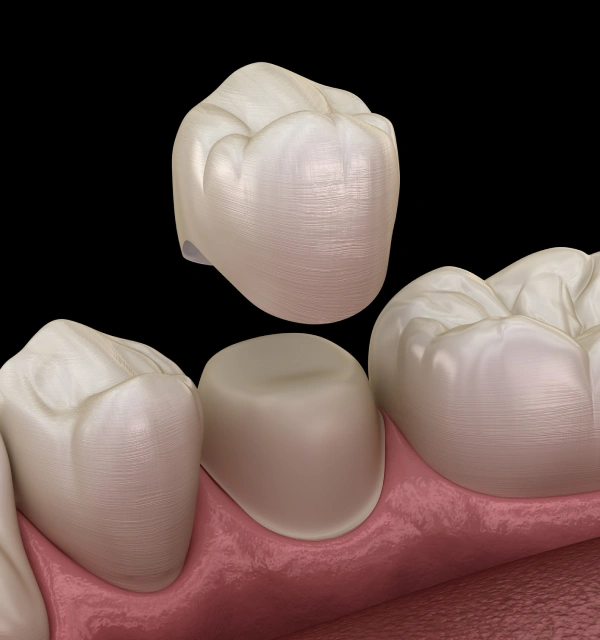
A crown is a custom-made cap that covers the entire visible portion of a tooth, restoring its shape, size, strength and appearance. Patients often call it a cap, and that describes it accurately.
Making room for it is what the preparation appointment involves. A thin layer of the outer tooth surface is reduced on all sides so the crown can sit over it without adding bulk, then the shape is recorded and the crown is fabricated to fit that specific tooth in that specific bite. Once cemented, it becomes the functional outer surface of the tooth, while the natural structure underneath, along with the root and the nerve, remains in place.
That distinction matters. A crown is not a replacement tooth. It is a protective covering over a tooth you still have, which is why crowns are used to avoid extraction rather than to follow it. When a tooth is genuinely gone, an implant or a bridge fills the space instead.
When a Crown Is the Right Treatment
Our dentists recommend a crown when a tooth needs more protection than a filling can provide. The common situations include:
- A cracked or fractured tooth, where a crown holds the segments together and prevents the crack from propagating toward the root
- A tooth with a large or repeatedly replaced filling, where remaining walls are too thin to withstand chewing forces
- After root canal therapy, particularly on back teeth, since a treated tooth is hollow inside and prone to splitting without full coverage
- Extensive decay that has destroyed too much structure for a filling to hold
- Severely worn teeth, often from grinding or acid erosion, where height and function need rebuilding
- A tooth with a failing older crown that has developed decay at the margin or has fractured
- Significant discoloration or misshapen teeth, where a crown restores appearance along with function
- As part of a bridge, where crowns on the adjacent teeth support a replacement tooth between them
How Your Crown Is Made and Fitted
Traditional crown treatment takes two appointments spaced a couple of weeks apart, with a temporary crown protecting the tooth in between.
Examination and planning
Our dentist assesses the tooth, reviews digital imaging to check the root and surrounding bone, and confirms a crown is the appropriate restoration. Cost and insurance coverage are discussed before treatment begins.
Numbing the tooth
Local anesthetic is administered and tested before any work starts. Nitrous oxide and oral sedation are available for patients who want them.
Preparing the tooth
Any decay or failing filling material is removed first. The tooth is then reshaped, reducing it slightly on all surfaces to create room for the crown. If a large amount of structure is missing, a build-up is placed to give the crown a solid foundation.
Recording the shape
An impression or digital scan captures the prepared tooth, the neighboring teeth and how your teeth meet when you bite. Accuracy at this stage determines how well the finished crown fits, so it is not rushed.
Matching the shade
The shade is selected against your surrounding teeth in good light. Natural teeth are rarely a single flat colour, so this involves matching depth and character rather than picking one swatch.
Placing a temporary crown
A temporary crown protects the prepared tooth and keeps the space open while the permanent one is made. It is cemented lightly so it can be removed easily, which is why it needs a bit of care with hard and sticky foods.
Fabrication
The permanent crown is made to the specifications recorded, typically taking around two weeks.
Fitting the permanent crown
The temporary comes off and the new crown is tried in. Our dentist checks the fit at the margin, the contact with adjacent teeth, the shade against neighboring teeth and how it meets the opposing tooth when you bite and move your jaw side to side. Adjustments happen at this stage until the bite feels right to you as well as measuring correctly.
Cementing and final check
Once everything is confirmed, the crown is cemented permanently, excess cement is cleaned away and the bite is verified one final time.
Living With a Crown and Making It Last
A well-made crown commonly lasts ten to fifteen years, and plenty last considerably longer. What determines the outcome is rarely the crown itself. It is the health of the natural tooth underneath it.
The crown material does not decay, but the junction where it meets the tooth at the gumline is still vulnerable, and decay forming at that margin is the most common reason a crown eventually needs replacing. That makes brushing and cleaning between teeth around a crowned tooth just as important as anywhere else, arguably more so. Flossing around the margin, or using an interdental brush if that reaches better, protects the part of the tooth that can still fail.
Grinding is the other major factor. Sustained clenching stresses ceramic and can fracture a crown or loosen it over time, so patients who grind are usually advised to wear a nightguard. Habits like chewing ice, biting fingernails and opening packaging with your teeth put point loads on the material that it was not designed for.
Beyond that, a crown needs nothing unusual. Regular cleanings and exams let our dentists check the margin, the surrounding gum tissue and the bone level on imaging, which is how a problem gets caught while it is a small repair rather than a replacement. If a crown ever feels loose, tell us promptly, since a loose crown lets bacteria beneath it where decay progresses out of sight.
Protect a Cracked or Weakened Tooth in West Omaha
A tooth that is cracked, heavily filled, or sensitive when you bite down is telling you something, and acting on it is considerably easier than dealing with a fracture that reaches the root. Our dentists will examine the tooth and tell you honestly whether a crown is needed, whether a filling would do, or whether the tooth needs something else entirely.
Request an appointment online or call our Omaha office at 402-991-6965, and our team will find a time that fits your schedule.
Book Now