Dental Emergency? Call Us First

Filling the Space Before the Rest of Your Bite Shifts
Teeth work as a set. Each one is held in position partly by the teeth on either side of it and partly by the tooth it meets when you bite. Remove one from that arrangement and the balance goes with it. The teeth beside the space begin tipping toward it over months and years, while the tooth opposite, no longer meeting anything, drifts out of position. Chewing forces redistribute onto teeth that were not designed to carry them, and cleaning becomes harder around teeth that have tilted out of alignment.
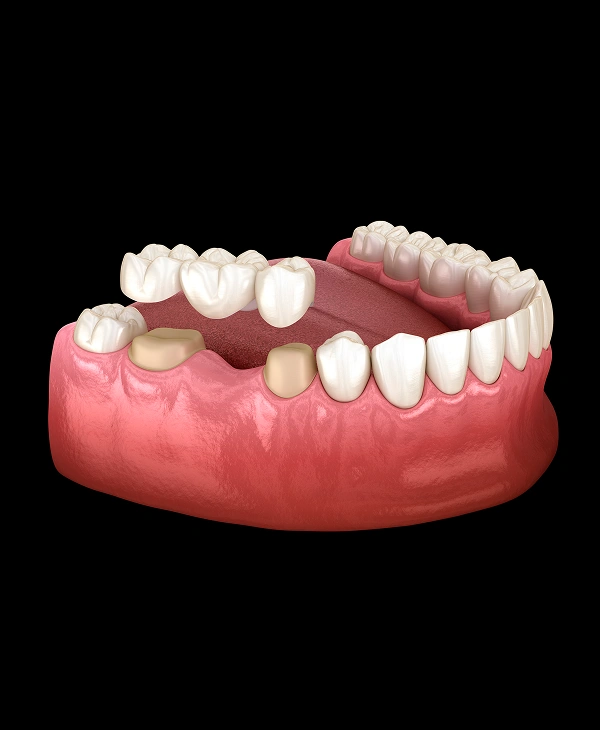
A dental bridge fills the gap with a custom-made replacement tooth anchored to the neighboring teeth. Bridges are a fixed, non-removable solution for replacing one or several missing teeth in a row, helping restore your smile, maintain proper alignment, and improve everyday function.
Schedule a Consultation
What Is a Dental Bridge?
A bridge is a fixed restoration that spans a gap left by one or more missing teeth. It has two parts working together: the replacement tooth in the middle, called a pontic, and the crowns on either side that anchor it to the natural teeth bordering the space. Those supporting teeth are known as abutments.
The whole unit is fabricated as a single piece, then cemented onto the prepared abutment teeth. Once fitted, it stays in place permanently and is not removed for cleaning, which is the main practical difference between a bridge and a partial denture. You brush it as you would your other teeth, with some additional attention to cleaning underneath the pontic.
Is a Bridge Right for Your Situation?
A bridge tends to be a good fit when:
- One tooth, or two to three teeth in a row, are missing
- The teeth on both sides of the gap are present and structurally sound enough to support crowns
- Those neighboring teeth already need crowns due to cracks, large fillings or previous root canal treatment
- The bone and gum tissue in the area are healthy
- You want a fixed restoration rather than something removable
- An implant is not viable, whether because of insufficient bone, a medical condition affecting healing, or a preference to avoid surgery
- You would rather complete treatment within a few weeks than across several months
A bridge is less likely to be the right choice when the teeth beside the gap are completely healthy and untouched, since crowning sound teeth to support a bridge is a genuine cost. It is also unsuitable when those teeth have significant bone loss from periodontal disease, because they will not withstand the additional load. Long spans of four or more missing teeth in a row generally need implant support rather than natural teeth alone, and active gum disease needs treating before any bridge is placed.
Building and Fitting Your Bridge
A traditional bridge takes two appointments, generally two to three weeks apart, with a temporary bridge in place between them.
Examination and planning
Our dentist examines the gap and the teeth on either side, and reviews digital imaging to check root condition and bone levels around the abutment teeth. This confirms those teeth can carry the load. Treatment options, timeline and cost, including insurance coverage, are all discussed before anything begins.
Preparing the abutment teeth
The area is numbed, then the teeth on either side of the gap are reshaped to receive crowns, reducing them slightly on all surfaces. Any decay or failing filling material is removed first, and a build-up is placed where a tooth needs additional foundation.
Recording the shape and bite
An impression or digital scan captures the prepared teeth, the gap, the opposing teeth and how your bite comes together. This is what the bridge is fabricated against, so accuracy here determines how well it fits and functions.
Matching the shade
The shade is selected against your surrounding teeth in good light, matching depth and character rather than a single flat colour.
Placing a temporary bridge
A temporary bridge protects the prepared teeth, keeps the space open and lets you eat and speak normally while the permanent one is made. It is cemented lightly so it can be removed easily, which is why it needs some care with hard and sticky foods.
Fabrication
The permanent bridge is made as a single unit to the specifications recorded, typically over two to three weeks.
Fitting and adjusting
The temporary comes off and the bridge is tried in. Our dentist checks the fit of both crowns, the contact with the adjacent teeth, the shade, the space beneath the pontic where you will need to clean, and how the bridge meets the opposing teeth when you bite and move your jaw. Adjustments are made until it measures correctly and feels right to you.
Cementing
Once confirmed, the bridge is cemented permanently, excess cement is removed and the bite is verified a final time.
Cleaning instructions
Before you leave, our team shows you how to clean underneath the pontic, which is the one part of caring for a bridge that differs from your normal routine. This matters more than it sounds, and it is worth the few minutes it takes to learn properly.
How Long Bridges Last and What Happens Next
A dental bridge often lasts 10–15 years or longer with proper care. Its lifespan depends less on the bridge itself and more on the health of the supporting teeth. Good brushing, flossing, and healthy gums help prevent decay and bone loss that can shorten its life.
During routine exams, our dentists check the bridge, supporting teeth, and surrounding gums for early signs of wear or problems. Contact us if you notice looseness, sensitivity, persistent bad taste, gum bleeding, or changes in your bite. If a bridge eventually needs replacement, we'll evaluate the supporting teeth and recommend the most appropriate next step, which may include another bridge or a dental implant.
Close the Gap and Get Back to Chewing Normally
A missing tooth is easier to address before the teeth around it have shifted. Our dentists will examine the space, review your bone and the condition of the neighboring teeth, and explain honestly whether a bridge, an implant, or a partial denture makes the most sense for your situation.
Request an appointment online or call our West Omaha office at 402-991-6965, and our team will find a time that suits your schedule.
Book Now