Dental Emergency? Call Us First
Replace Missing Teeth with Confidence
Most tooth replacement options restore the visible part of your smile but do not replace the missing tooth root. Bridges rely on neighboring teeth for support, while dentures rest on the gums. Without a tooth root to stimulate the jawbone, the bone beneath the missing tooth gradually shrinks over time, which can affect your facial structure, denture fit, and future treatment options.
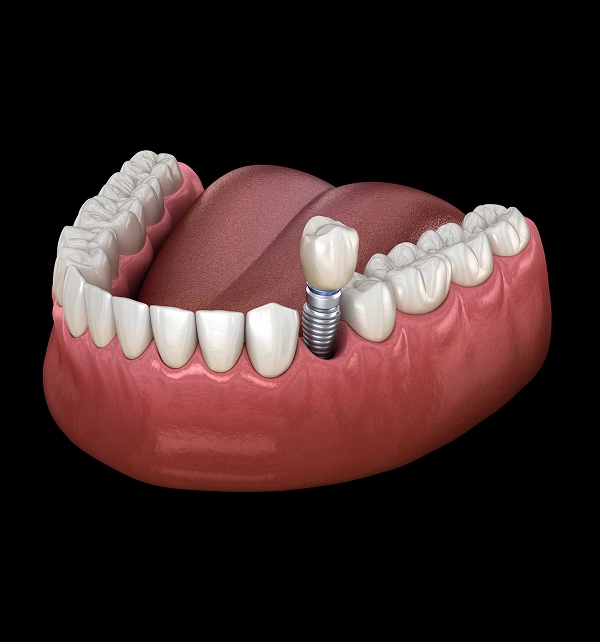
A dental implant replaces both the root and the visible portion of the tooth. A small titanium post is placed in the jawbone, where it fuses with the surrounding bone to create a strong, stable foundation for a custom crown. This helps preserve bone, restores natural chewing function, and provides a replacement tooth that looks, feels, and functions much like your own.
Schedule an Implant Consultation
What Is a Dental Implant?
An implant is not a single object but a system of three parts working together.
The implant post is a small screw shaped titanium fixture placed into the jawbone in the position the natural root occupied. Titanium is used because bone tolerates it exceptionally well and grows directly against its surface, a process called osseointegration. That biological bond is what gives an implant its stability, and it is why the healing period between placement and the final crown is not optional.
The abutment is a connector that attaches to the post and extends through the gum tissue, providing the platform the restoration sits on. It is fitted once integration is complete.
The restoration is the visible part, most often a custom crown matched in shade, shape and translucency to the teeth around it. Where several teeth are missing, the restoration may instead be a bridge or a denture supported by multiple implants.
The distinction from a bridge is worth stating plainly. A bridge requires reshaping the healthy teeth on either side of the gap and crowning them permanently. An implant stands independently in the space where the tooth was, so those neighbors are untouched. Preserving healthy tooth structure is one of the strongest arguments in an implant's favor.
Types of Dental Implants and Implant Restorations
The right configuration depends on how many teeth are missing, where they sit and how much bone is available.
Single Tooth Implants
One post supporting one crown, replacing an individual missing tooth. This is the most common implant treatment and the most straightforward. It leaves both neighboring teeth completely untouched, which is the main advantage over a bridge spanning the same gap.
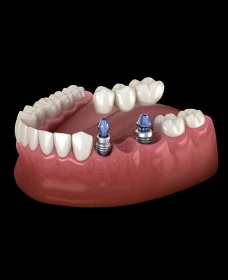
Implant-Supported Bridges
Where two or more adjacent teeth are missing, implants at each end can support a bridge between them. This avoids placing an implant for every single missing tooth while still keeping natural teeth out of the equation. It is a common solution for a run of three or four missing teeth.
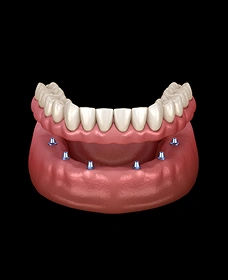
Implant Supported Dentures
A full arch restoration anchored to implants rather than resting on the gum ridge. This addresses the most frequent complaint about conventional lower dentures, which is looseness, since the lower jaw has no palate to assist with suction. Two configurations exist: removable overdentures that snap onto implant attachments and come out for cleaning, and fixed full arch bridges that stay permanently in place and are cleaned like natural teeth.
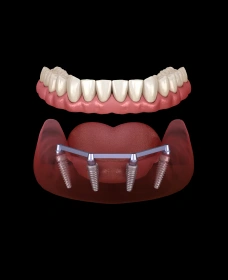
All-on-4 and Full Arch Implant Treatment
A technique using four to six strategically angled implants to support a complete arch, often placed in a way that takes advantage of denser bone and reduces or eliminates the need for grafting. It appeals to patients wanting a full arch restored with fewer implants and a shorter overall timeline.
Our dentists will assess your bone volume and density on imaging, evaluate the site and your bite, and explain which of these are genuinely viable for you. Not every option suits every mouth, and you will hear which ones are realistic rather than a survey of everything that exists.
Are You a Candidate for Dental Implants?
Implants suit a wide range of patients, and assessment centers on a handful of factors.
- Adequate jawbone to support the implant (bone grafting may help if bone has been lost).
- Healthy gums free from active periodontal disease.
- Good overall health, including well-controlled medical conditions that support healing.
- Non-smoker or willing to quit, as smoking increases the risk of implant failure.
- Commitment to the treatment timeline, which includes several months of healing.
- Additional procedures, such as bone grafting or a sinus lift, may be recommended to prepare the implant site.
- Timely tooth replacement helps preserve bone and can simplify implant treatment.
- Jaw growth must be complete, so implants are typically placed after the late teens or early twenties.
Your Implant Treatment Timeline
Implant treatment takes place over months rather than weeks, and the waiting is doing real work. Bone integration cannot be hurried, and it is what makes the result last.
Consultation and imaging
Our dentist examines the site, evaluates your bite and reviews imaging to assess bone volume, bone density and the position of nerves and sinuses. This is where the treatment plan, timeline and full cost including insurance coverage are established.
Preparatory treatment if needed
Extraction of a remaining tooth, periodontal treatment, or bone grafting happens first. Where grafting is required, healing takes several months before placement.
Implant placement
A minor surgical procedure performed under local anesthetic, with sedation available. The gum is opened, a channel is prepared in the bone, and the post is positioned precisely. The site is then closed with sutures. Most patients report considerably less discomfort than anticipated, and many compare recovery favorably to an extraction.
Osseointegration
The healing period during which bone grows against the implant surface, typically three to six months depending on the site and your bone quality. A temporary restoration can usually be provided so a visible gap is not left during this time.
Abutment placement
Once integration is confirmed, the abutment is attached to the post. Sometimes this happens at the initial placement appointment, and sometimes it is a separate short procedure.
Recording the restoration
An impression or digital scan captures the abutment position, the neighboring teeth and your bite, which the final crown is fabricated against.
Fitting the final restoration
The crown is tried in, checked for fit, contact with adjacent teeth, shade and how it meets the opposing tooth. Adjustments are made until it functions and looks correct, then it is secured.
Follow-up
Our dentists check the implant, the surrounding tissue and the bone level on imaging at routine visits from that point forward.
What an Implant Protects That Other Options Cannot
Two things make implants distinct, and both are about the long term rather than the immediate result.
The first is bone preservation. Because the post transmits chewing force into the jaw the way a root did, the bone at that site continues to be used and continues to maintain its volume. Every alternative leaves the socket unloaded, and unloaded bone resorbs. Over a decade, that difference is visible in the jawline and consequential for any future treatment. Patients with long-standing dentures often discover the ridge has resorbed so far that implants would now require extensive grafting, which is the cost of waiting.
The second is that neighboring teeth stay untouched. A bridge requires permanently crowning the healthy teeth on either side of a gap, and those teeth become part of the restoration. If one later develops decay beneath its crown or loses bone support, the whole bridge is affected. An implant carries its own load independently, so a problem at one site does not cascade.
There is a third benefit that patients tend to describe rather than anticipate: an implant crown does not require thinking about. There is no appliance to remove, no adhesive, no clasps, no adapting how you chew. Patients who have worn a partial denture and then moved to an implant frequently say this is the difference that mattered most.
Find Out Whether Implants Are Right for You
An implant consultation gives you concrete answers rather than general information: whether you have the bone for it, whether grafting would be needed, what the timeline looks like and what it costs. Our dentists will also tell you honestly where a bridge or a partial would serve you better, since implants are not the right answer in every situation.
Request an appointment online or call our West Omaha office at 402-991-6965, and our team will find a time that suits your schedule.
Book Now