Dental Emergency? Call Us First
Restoring Function When Several Teeth Are Gone
Losing one tooth affects a single area, but losing several can change how your entire mouth functions. Chewing shifts to the remaining teeth, increasing wear over time, while missing teeth can make eating certain foods, speaking clearly, and smiling with confidence more difficult.
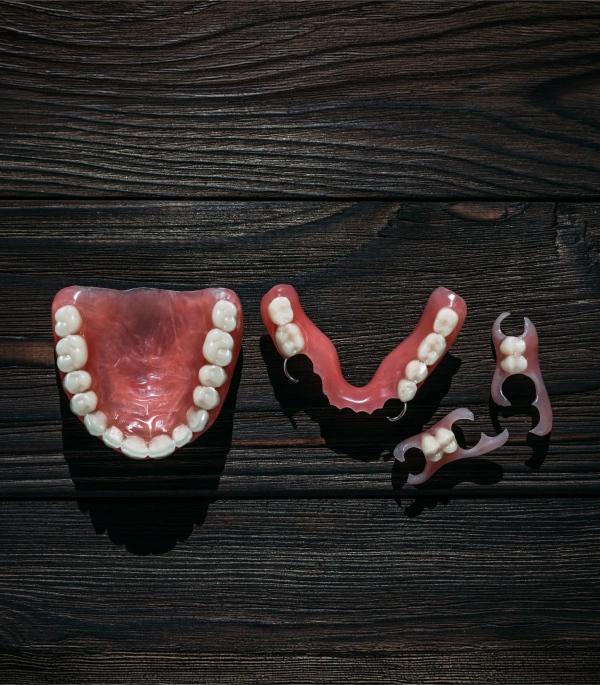
Dentures restore missing teeth and help improve chewing, speech, facial support, and overall comfort. Partial dentures replace several missing teeth while preserving your natural ones, while full dentures restore an entire arch. At Whispering Ridge Family Dentistry, our dentists take precise impressions, carefully check your bite, and make adjustments throughout the process to ensure your dentures fit comfortably and function naturally.
Schedule a Consultation
What Are Dentures and Partial Dentures?
A denture is a removable appliance that replaces missing teeth along with the gum tissue that surrounds them. The teeth themselves are made from durable acrylic or composite, set into a base shaped to your mouth so it sits stably and looks natural.
A complete denture replaces all the teeth in an arch, either upper or lower or both. It rests on the gum ridge and, in the upper jaw, gains additional stability from suction across the palate. Nothing anchors it to natural teeth, because there are none left in that arch to anchor to.
A partial denture replaces some teeth while leaving your remaining natural teeth in place. It uses those teeth for support and retention, either through metal clasps that grip discreetly or through a flexible base that holds without visible metal. Partials matter for a reason beyond filling gaps: they stop the remaining teeth from drifting into the spaces, which is what eventually leads to losing more of them.
The main practical difference from bridges and implants is that dentures are removable. They come out for cleaning and generally overnight, which is straightforward once it becomes routine, and it makes cleaning both the appliance and your mouth considerably easier than working around something fixed.
Deciding Between a Partial, a Full Denture and Other Options
The right answer depends on how many teeth are missing, the condition of those remaining and what matters most to you.
A partial denture generally suits patients who:
- Are missing several teeth in one or both arches but retain healthy natural teeth
- Have gaps in more than one area of the same arch, which a bridge cannot span
- Have lost too many consecutive teeth for a bridge to be supported safely
- Want a removable option that does not require crowning healthy teeth
- Are working within a budget where implants are not currently realistic
A complete denture generally suits patients who:
- Have lost all teeth in an arch, or have remaining teeth that cannot be saved
- Have significant bone loss from long term periodontal disease
- Want a full arch restored within a defined timeline
Implant-supported options are worth considering when:
- Stability, particularly of a lower denture, is the priority
- Enough bone remains, or grafting is viable
- Preserving bone long term matters to you
- You would rather avoid an appliance that moves during eating or speaking
How Your Dentures Are Made
Denture treatment happens across several appointments, and that sequence is what produces a fit worth wearing. Rushing it is the most common reason dentures end up uncomfortable.
Examination and planning
Our dentist examines your remaining teeth, gum tissue and ridge, and reviews imaging to assess bone levels. Any extractions or periodontal treatment needed first are planned at this stage, along with which denture type suits you, the timeline and the cost including insurance coverage.
Preliminary impressions
An initial impression captures the general shape of your mouth and is used to make a custom tray for the more detailed impression that follows.
Final impressions
Taken with a custom tray shaped to your mouth, these record the ridge, the surrounding tissue and the borders where the denture will sit. This is the appointment that determines fit, so it is worth the time it takes.
Bite registration
Our dentist records how your jaws relate to each other and where the teeth need to sit for comfortable chewing. Measurements here also establish the correct height, which affects both function and how natural your face looks.
Wax try-in
The teeth are set in wax and tried in your mouth. You see the shape, the shade, the tooth position and the appearance before anything is finalized, and you speak with it in place. This is the point at which changes are easy, so it is the moment to say if something does not look or feel right.
Fabrication
Once you approve the try-in, the denture is processed into its final materials.
Delivery and fitting
The finished denture is fitted, the bite is checked, and pressure points are identified and relieved. Our dentist and team show you how to insert and remove it, how to clean it and what to expect through the adjustment period.
Adjustment appointments
Sore spots in the first weeks are normal and expected, not a sign something went wrong. Tissue takes time to adapt, and small relief adjustments make a substantial difference. These visits are part of the treatment rather than a complication.
Adjusting to New Dentures
The first few weeks with new dentures take some adjustment. They may feel bulky at first, and increased saliva or minor sore spots are common as your mouth adapts. Follow-up adjustment visits help improve comfort, so let us know if you notice areas of irritation.
Start with soft foods, take small bites, and chew evenly on both sides to keep your dentures stable. Speech usually improves within a couple of weeks, especially with a little practice. Lower dentures can be more challenging than upper ones, and if stability remains a concern after the adjustment period, implant-supported dentures may provide a more secure solution.
Talk to Our Omaha Dentists About Replacing Missing Teeth
Whether you are missing a few teeth or facing the loss of an arch, the options are broader than most patients expect, and there is usually more than one reasonable path. Our dentists will examine your mouth, review your bone levels and explain honestly what each option involves, including where saving your remaining teeth is still possible.
Request an appointment online or call our West Omaha office at 402-991-6965, and our team will find a time that fits your schedule.
Book Now